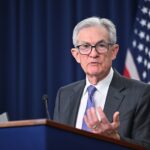
Notable comments from Chairman Powell during today’s FOMC press conference and announcement.
From the FOMC statement:
- “The Committee is attentive to the risks to both sides of its dual mandate and judges that downside risks to employment rose in recent months.” : The Fed continues to communicate that the policy goal they are most concerned about deviating from its intended target is employment. Even though inflation has risen to 2.8-3%, well above their 2% goal, they are doubling down on their conclusion that the recent tariff-induced inflation represents a one-time price adjustment rather than the start of a broader inflationary process.
- “The Committee decided to conclude the reduction of its aggregate securities holdings on December 1.” : The Fed announced the end of its quantitative tightening program, further enhancing its ability to influence long-term interest rates. This move aligns with its ongoing rate cuts, effectively coordinating balance sheet policy with reductions in the federal funds rate. By maintaining a larger balance sheet, the Fed can exert greater influence over longer-term yields by extending the maturity of its holdings, without expanding the balance sheet through additional quantitative easing.
From the FOMC press conference
- ‘We will continue to allow agency securities to run off our balance sheet and will reinvest the proceeds from those securities in Treasury bills, furthering progress toward a portfolio consisting primarily of Treasury securities.”: As the Fed transitions toward a balance sheet composed “primarily of Treasuries,” the reinvestment of maturing agency securities will place additional downward pressure on Treasury yields, particularly at the longer end of the curve, as roughly $2 trillion in agency holdings mature and are reinvested into Treasuries. One of the major criticisms of the Fed’s pandemic-era quantitative easing was that it overextended into the mortgage market by heavily purchasing agency MBS, even as rates were already at record lows. This contributed to an average 30-year mortgage rate of just 2.9% in September 2021, closely tracking the decline in the 10-year Treasury yield.
- “…situation where the risks are to the upside on inflation and to the downside on employment…one tool can’t address both of those at once.”: Powell addressed a reporter’s question by noting that when the Fed’s dual mandate is in conflict, as it is now, it calls for opposing policy responses, an uptick in inflation would warrant tighter policy, while an increase in unemployment would justify a loosening of policy.
- “We have now moved 150 basis points and that we are down into that range between 3 and 4…many estimates of the neutral interest rate live in that 3 to 4% range.”: Powell reiterated that a December rate cut was not a foregone conclusion, “far from it.” In defending the rate cut amid a 3% CPI reading, he argued that when the effects of tariff-related inflation are stripped out, adding approximately 0.5 to 0.6 percentage points to an estimated PCE of 2.8%, inflation is actually much closer to the Committee’s 2% target. Powell emphasized that once the final round of tariffs is implemented, the overall price level will indeed be higher, but price increases will then level off, allowing measured inflation to return to underlying, non-tariff-driven levels going forward.
- “Ordinarily, the labor market is a better indicator of the momentum of the economy, than the spending data, that’s the lore, in this case that gives a more downbeat read.” : Referencing the outlook for future demand, Powell explained that the Committee’s decision to cut rates toward a more neutral level reflects its view that economic demand is likely to slow. By lowering interest rates at the margin, the Fed aims to support demand and, in turn, encourage continued hiring.
In summary, Powell doubled down on the Committee’s focus on a weakening labor market and its impact on the broader economy. He reiterated that the Committee will ensure one-time price increases driven by tariffs do not evolve into a sustained inflationary process and reaffirmed its commitment to keeping inflation expectations anchored. With the announcement of the end of quantitative tightening on December 1, the Fed has fully aligned its policy tools toward a looser monetary stance. The larger overall balance sheet, combined with the continued conversion of roughly $2 trillion in agency-backed MBS into Treasury securities, will give the Fed greater influence over longer-term rates. By extending the maturity of securities on its balance sheet, the Fed can place downward pressure on longer-term yields, stimulating credit and overall demand more effectively.
In theory, a higher neutral rate makes any move by the Fed to lower long-term rates more stimulative as real yields compress and credit conditions ease alongside them. Yet, as investors cheer for lower interest rates and the stock market charges higher, the reason behind the Fed’s easing becomes increasingly important. Powell again described the latest rate cut as “risk management.” If that’s the case and demand is slowing, the labor market is weakening, and elevated price levels continue to pressure consumption, the economy could be headed toward a perfect storm. Interest rates may fall, but investors should be careful what they wish for. Unfortunately, history has often proven the saying true: “The Fed’s brake pedal is better than its gas pedal.”

Source: Federal Open Market Committee (FOMC), Press Conference, October 29, 2025
The content is developed from sources believed to be providing accurate information. The information in this material is not intended as tax or legal advice. It may not be used for the purpose of avoiding any federal tax penalties. Please consult legal or tax professionals for specific information regarding your individual situation. This material was developed and produced to provide information on a topic that may be of interest. The opinions expressed and material provided are for general information, and should not be considered a solicitation for the purchase or sale of any security.
CAPATA Financial LLC offers wealth management services through various unaffiliated companies including advisory services offered by Diversify Advisory Services (“Diversify”) an SEC registered investment adviser. CAPATA Financial LLC offers additional investment services and securities through DFPG Investments, LLC., a broker/dealer, member FINRA / SIPC, and an affiliate of Diversify.